
Revocal › The reverse singing challenge
The reverse singing challenge, explained
The reverse singing challenge is the trend where someone sings a line of gibberish at the camera, then plays the clip backwards and the gibberish turns into a real song lyric. Here is how it works and how to do it yourself.
What is the reverse singing challenge?
Take a line from a song. Record it, then play the recording backwards. What you hear is nonsense: vowels in the wrong places, consonants that pop in reverse, a tune that runs the wrong way. The challenge is to sing that nonsense yourself, record your attempt, and reverse it. If you copied the backwards sounds closely enough, your reversed attempt comes back as the original line.
The video has two halves. First the performance, which sounds like nothing at all. Then the same clip reversed, where you suddenly sing the lyric. The gap between the two is the joke, and it is why the format travels so well on TikTok, Instagram Reels and YouTube Shorts.
How to do the reverse singing challenge
- Pick a short line. Three to five words from a chorus. Long lines are where most attempts fall apart.
- Record the real line and reverse it. This is your target: the backwards sounds you have to reproduce.
- Learn the backwards version by ear. Loop it, slow it to half speed, and copy it a chunk at a time. Ignore the spelling of the words entirely.
- Film your attempt. One take, facing the camera, singing the backwards version with a straight face.
- Reverse your attempt. If it sounds like the real line, you are done. If not, find the chunk that went wrong and drill just that part.
- Post both halves. The attempt first, then the reveal. Put the words on screen so people can follow the reveal.
Doing that with a voice memo and a video editor is slow. In Revocal the reversing, the slowed-down practice loop, the filming and the reveal are one flow, and the finished video already has both halves and the words on it.
Which lines work best
Some sounds reverse cleanly and some fight you. Vowels, m, n and l flip into sounds you can make. Hard consonants like p, t and k flip into sounds English doesn't have, with the puff of air arriving before the stop instead of after it. So for a first attempt:
- Pick lines with long, open vowels you can hold.
- Avoid fast verses and rap. Speed makes every mistake audible.
- Choose something people will recognise within two words of the reveal.
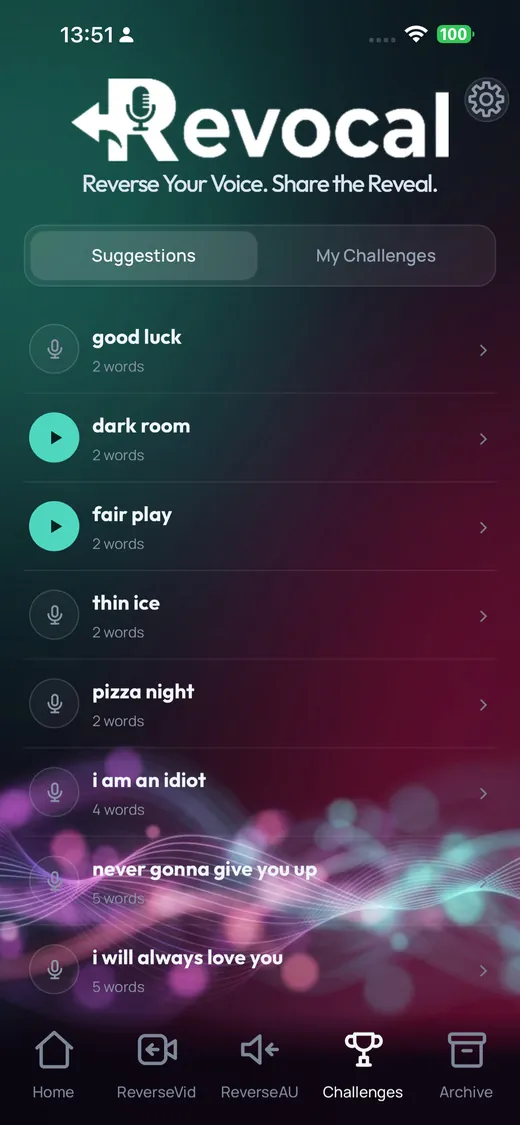
- Two-word phrases are a good warm-up. Revocal's own suggestions start with ones like good luck, dark room and fair play.
Tips for posting it
- Lead with the attempt. The gibberish is the hook. The reveal is the payoff.
- Commit to the performance. The funniest clips play the backwards gibberish completely straight.
- Show the words during the reveal. Viewers scrolling with the sound low still get the joke.
- Tag it so people find it: #reversesinging, #reversesingingchallenge, #singingbackwards.
Questions
Is the reverse singing challenge hard?
Harder than it looks. Most people need five to ten attempts on a short line before the reversal is recognisable. Short lines, slowed-down practice and working in chunks make it far easier.
What app do people use for the reverse singing challenge?
Any app that can play audio backwards will get you started. Revocal is built for the whole challenge: it reverses the line, loops it slowed down for practice, films your attempt, reverses the video as well as the sound, and exports the reveal with the words on screen.
Do you have to sing in tune?
It helps to follow the reversed melody, but the words are what people listen for. Get the sounds right first, then the tune.
Try it with Revocal
Revocal flips any line, plays it back slowed down until you can copy it, then films one take and plays you back forwards. Free on iPhone.